
Turning Japanese- 242 Vocabulary Words and Growing!
If you're an anime otaku, you're bound to come across a few situations where you don't want to seem like an ignorant Gaijin (foreigner). Here to help you in those cases is the ToT's "Turning Japanese" Vocabulary and Common Phrase" Guide! Even though I've only haven about 12 weeks of college Japanese, I know enough to pass on my knowledge to other people. The more I learn, the more will be posted here, so stay tuned!
This guide can be used for many things, such as:
Hiragana Chart
courtesy of Super Majin Tom
Katakana (for foreign words) Chart
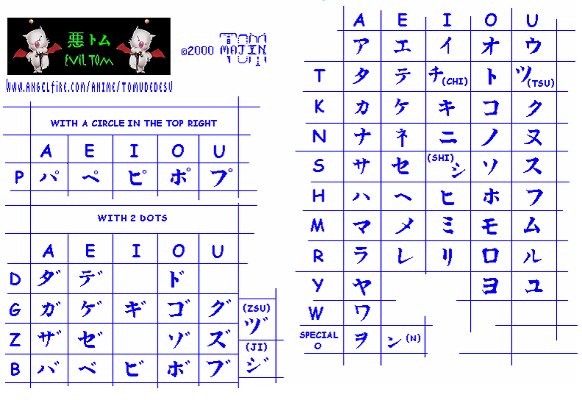
courtesy of Super Majin Tom
Lesson 1: Greetings/Salutations
Ohayoo gozaimasu = Good morning
Konnichi wa = Hello; good afternoon
Konban wa = Good evening
Sayoonara = Good bye
Lesson 2: Common, Every-day Phrases
Ee, soo desu = That is right
Iie, chigaimasu = That is wrong; you are mistaken
Kyoo wa ii tenki desu ne = Nice weather today, isn't it?
Sumimasen = Excuse me
Arigatoo (gozaimasu) = Thank you (polite form)
Doo itashimashite = You're welcome
Hajimemashite = Nice to meet you
Chooto maate = wait for a moment
Ii desu = it's ok
Hai (ee) = yes
Iie = no
NAME-san = Mr./Ms./Mrs.
NAME-senee = Teacher; Professor
COUNTRY-jin = [Nationality]
COUNTY-go = [Language]
NOUN + desu = to be; am; is; are
NOUN + wa = [Topic]
SENTENCE + ka = [Question]
Lesson 3: Numbers
ichi = 1 ni = 2 san = 3 shi (yon) = 4 go = 5 roku = 6 shichi (nana) = 7 hachi = 8 ku (kyuu) = 9 juu = 10 |
juu-ichi = 11 juu-ni = 12 juu-san = 13 juu-yon = 14 juu-go = 15 juu-roku = 16 juu-nana (juu-shichi) = 17 juu-hachi = 18 juu-kyu = 19 ni-juu = 20 |
san-juu = 30 yon-juu = 40 go-juu = 50 roku-juu = 60 nana-juu = 70 hachi-juu = 80 kyuu-juu = 90 hyaku = 100 sen = 1000 |
Lesson 4: Time
NUMBER + ji = __ o' clock
NUMEBER + ji-han = half past....
Gozen = A.M.
Gogo = P.M.; afternoon
Ima = Now
Asa = Morning
Hiru = Daytime; noon
Yoru = Night; evening
Lesson 5: Vocabulary - Part 1
Hon = Book
Jisho = Dictionary
Enpitsu = Pencil
Tsukue = Desk
Isu = Chair
Kasa = Umbrella
Tokee = Watch; clock
Kaban = Bag
Kutsu = Shoes
Kustu-shita = Socks
Mado = Window
Tatemono = Building
Gakkoo = School
Toshokan = Library
Byooin = Hospital
Lesson 6: Colors
Akai = Red
Shiroi = White
Aoi = Blue
Kuroi = Black
Lesson 7: Common Questions
Ikura desu ka? = How much is it?
Nan-ji desu ka? = What time is it?
Wakarimasu ka? = Do you understand?
Ii desu ka? = Is it ok?
O-namae wa nan desu ka? = What is your name?
Lesson 8: Places
Daigaku = University; college
Kyooshitsu = Classroom
Yuubinkyoku = Post office
Ginkoo = Bank
Kissaten = Coffee shop
Shokudo = Dining room
Hoteru = Hotel
Chikatetsu = Subway
Lesson 9: People
Watashi = I; me
Hito = Person; people
Kodomo = Child
Otoko = male
Otoko no hito = man
Otoko no ko = boy
Onna = female
Onna no hito = woman
Onna no ko = girl
Go-shujin = Husband
Okusan = Wife
Gakusee = Student
Sensee = Teacher
Lesson 10 : Locations
Ue = Top; on; above
Shita = Bottom; underneath; below
Naka = Middle; inside; in
Mae = Front; before
Ushiro = Back; behind; rear
Tonari = Next to; adjacent
Soba = Near; close by
Yoko = Side; beside
Koko = this place; here
Soko = this place; there
Asoko = that place; over there
Doko = which place?
Lesson 11: Vocabulary - Part 2
Tenki = Weather
GOHAN! (hehe, I couldn't resist) = meal; cooked rice
Mizu = Water
Ocha = Tea
Terebi = Television
Eega = Movie
Shinbun = Newspaper
Zaashi = Magazine
Uchi = home; house
Kaisha = Office; company
Eki = (train) station
Neko = Cat
Inu = Dog
imasu = there is; (for things that are alive)
arimasu = there is; (for things that are not alive)
Lesson 12: Days of the Week
Nichiyoobi = Sunday
Getsuyoobi = Monday
Kayoobi = Tuesday
Suiyoobi = Wednesday
Mokuyoobi = Thursday
Kinyoobi = Friday
Doyoobi = Saturday
Nan-yoobi = what day of the week
Lesson 13: When Things Occur
Kyoo = Today
Ashita = Tomorrow
Kinoo = Yesterday
NOUN + no + ato = after...
Taitei = Usually
Tokidoki = Sometimes
Sugu = Immediately
Mada = Not yet
Mou = Already; any more
Hayai = Early; fast
Osoi = Late
TIME + goro = around...; about...
Lesson 14: Verbs
Wakaru = to understand
Hajimaru = to begin; to start
Owaru = to end
Kaeru = to return
Iku = to go
Yomu = to read
Nomu = to drink
Taberu = to eat
Miru = to see
Okiru = to wake up
Neru = to go to sleep
Kuru = to come
Benkyoo shimasu = to study
Shigoto shimasu = to work
Au = to see (a person); to meet
Tariru = to be enough
Hanasu = to talk; to chat; speak
Korosu = to kill
Kiku = to listen to; to hear
Tsukau = to use
Mitsu = to wait
Yobu = to call; to invite
Shinu = to die
Isogo = to be in a hurry
Tatsu = to stand up
Yakutatatsu = to be helpful
Ganbaru = to try one's best
Tasukaru = to be saved; to help out
Agaru = to enter a Japanese style house
Lesson 15: Vocabulary- Part 3
Yakyuu = Baseball
Suiei = Swimming
Supootsu = Sports
Ame = Rain
Yuki = Snow
Kami = Paper
Shosetsu = Novel
Koukou = High school
Bangumi = Progam (t.v, radio)
Koto = Thing
Tesuto = Test
Suteeki = Steak
Sarada = Salad
Beeru = Beer
Nooto = Notebook
Rekuudo = Record
Iroro = Various
Takai = Expensive
Demo = But; however
Hanashi = Story
Paatii = Party
Kaijyoo = Place of meeting
Tomodachi = Friend
Niku = Meat
Toriniku = Chicken
Yasai = Vegetable
Sakana = Fish
Tamago = Egg
Mise = Store
Tokoro = Place
Mono = Thing; object
Doo = How
Dooshite = How come?
Lesson 16: Sentence Particles
wa = [topic of sentence] example: watashi was genki = I am healthy (wa comes after the noun)
mo = [showing similarity; also] example: sensee wa nihon-jin. gakusee mo nihon-jin = The teacher is Japanese. The student is also Japanese.
e = [to go to a place] example: toshokan e ikimasu = go to the library
de = [to show that something is taking place somewhere] example: kissaten de benkyoo shimasu = study in the coffee shop
ga = [shows the noun as an object] example: neko ga imasu = there is a cat
ni = [shows location] example: Tsukue no ue ni hon ga arimasu = there is a book on top of the desk
no = [noun modification] example: watashi no hon = my book
o = [to show that something is being done to something] example: Mary ga John o korosu = Mary killed John
Lesson 17: Vocabulary - Part 4
Ookii = Large; big
Chiisai = Small
Yasui = Cheap
Atarashii = New
Furui = Old (not someone's age)
Oishii = Delicious
Hiroi = Spacious; wide
Isogashii = Busy
Hima = To have free time
Shizuka = Quiet
Nigiyaka = Lively; bustling
Kireina = Pretty; clean
Riipa = Impressive
Genki = Healthy; well; full of energy
Taihen = Tough
Zannen = Regrettable; too bad
Kouen = Park
Taihen = very; extremely
Omoshiroi = Interesting
Tsumaranai = Uninteresting; boring
Kiipo = Ticket