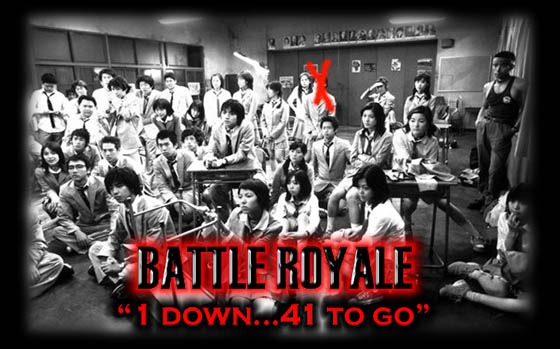
If you visit any Japanese animation or manga message board, there is an excellent chance that you have heard at least a whisper or two about Battle Royale. If you visit this site regularly, then you may have even read my impromptu review of the film. Well this time I'll try to bring out all the details about the horrifying success of quite possibly the most gruesome book, manga and film of our time, Battle Royale.
 Any film that immediately starts off with a crashing chaotic orchestra performing a section of Verdi's "Requiem" is bound to take you for a helluva ride. Why is this movie so fantastic? I'm hoping someone can tell me because I do not know why I like it. No, that's not true. I know why I like it. I like it because after seeing the film so many times I desensitized myself to the horrible horrible acts of violence displayed in front of me and instead of feeling ill, I root for the villains, cheer on the heroes and "boo" Kitano. I like the movie because now I watch it as a series of imagined events thus having removed myself from the pure terror I experienced when I first watched the film. That is why I like it, but for all intensive purposes I should be disgusted by it. I guess that's how these things go for some people. However, I will never forget the first time I watched the movie, sick to my stomach, as Kitano announced, "So then everyone...today you will kill each other off slowly", or when Megumi Eto's throat was slit open in full view of the camera by a sickle, and the time Yukiko and Yumiko were gunned down mercilessly, their screams of pain amplified by the megaphone they were just using to call for help, only to be droned out by the noise of the assailant's finishing shots to their bodies.
However, in a way we should expect nothing less from director Kinji Fukasaku who is no longer with us. How many films had Fukasaku completed before his death? Well, it is safe to say you couldn't count them on your fingers, it would take your and five of your friend's fingers; Kinji Fukasaku completed 60 feature films in his lifetime. Among his works was a little film some of you may recognize that goes by the name "Tora! Tora! Tora!". Yes, it was Fukasaku who picked up the reigns after Akira Kurosawa was banished from the project. Fukasaku never held back when displaying violence, and since many of his films involved crossing swords or guns, he was more than perfect to take on the task of directing something like Battle Royale. After all, he is also the man responsible for making Sonny Chiba famous in yakuza and tough guy roles. Sadly, during the production of Battle Royale II, Fukasaku died of bone cancer on January 12th 2003, before the completion of his 61st feature film; and so the torch was passed to his son, Kenta Fukasaku. However, Kinji expected to die and even said that if he passed away during filming, he would rather die doing what he loved and make Battle Royale II his final work.
Why did BR make it big? Well as mentioned earlier, the message had already struck a chord with readers of the book. But let us be perfectly honest here. What is the best way for a film to make cash? CREATE CONTROVERSY! Discussion on the release of Battle Royale went straight to the Diet, the Japanese parliament. It was proposed that the film be banned, but in the end it was hit with an R15 rating. That means no one under 15 would be admitted to the film. Just to put that in perspective, the Japanese release of "The Matrix" was not tagged with any age restriction. However, this is not a case of the government being overprotective. Although Japan is a relatively safe country, recently youth crime has been a problem and by youth crime I do not mean stealing videos or magazines. For example, in 1997 a 14-year-old boy from Kobe Japan progressed from killing birds, to cats, and classmates. But this was not as removed as the rifle incident in the United States, in this case, the boy severed the head of his 11-year-old victim and left it outside his school with a note, "This is the beginning of a game." As Battle Royale is a game of students killing students, it is obvious that the Diet's fears were in good taste.
Education Minister, Nobutaka Machimura, called for a toning down of the film's violence. The Diet's Opposition Leader, Koki Ishii accepted the need for film-makers to express themselves, but also said that the nation needed to protect itself against criminals. Ishii dismissed the film as "rubbish" and said it was the "lowest level" of film he had ever seen. He also contested that it was just created to raise controversy in order to make a profit. It is hard to disagree with Ishii when you see statements from Toei Studio's publicist, Kaoru Sugita like, "Since they started rocking the boat, there's been enormous publicity and many more people now want to see it.." In addition, it is hard to ignore that on the day "Battle Royale" was released a 17-year-old injured 8 people with a baseball bat. Be that as it may be, the film was a success among the youth of Japan and became a hit.
BR's film incarnation deviated slightly from the pulp version, but instead of taking out, Fukasaku added, or rearranged events/stories. There are some elements of the book that are left out of the film because they are a bit too extreme, as I described in the book review, but for the most part, both carry the same general story. The film does not take place in any specific year, only in an undefined future or possibly the present.
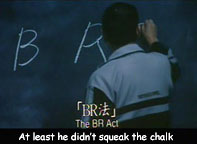 Themes of "The Great Dictator" and Republic of Greater East Asia are absent. Instead we are told that Japan is in a state of national chaos. Unemployment is 15% and as a result students are running amok. The Battle Royale Act was passed in order to keep students under control. Each year one class, not 50 as listed in the book, is selected for Battle Royale and brought to an unidentified location. In the book and movie, this location is an island. The students are to kill each other, until only one remains. Each student is outfitted with an explosive collar tracker. If the student tries to remove the collar, boom. If the student tries to swim away, boom. If the student enters a "danger zone", boom. If after three days, the game is NOT complete and more than one person is alive, BOOM! Everyone dies instantly.
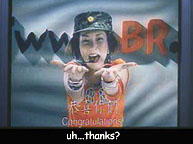 These instructions are given out to the students via a videotape that features a Battle Royale spokeswoman who addresses herself as "big sister". (As it so happens, this cutesy woman delivering horrible news is the seiyuu of Asuka from Neon Genesis: Evangelion) Then each student is given a map, bread, water, compass and you guessed it, a random weapon. The weapon could be anything: pistol, grenade, katana, binoculars, GPS, poison, nunchaku or even a pot lid.
to survive or kill. What makes the movie work? Well just like I said for the book, the film somehow manages to let you in on the secret lives of almost all 42 students. Obviously the film is somewhat more shallow than the book, but that is expected. Aside from most of those who perish the first night, the viewer can identify with each character. This is only enhanced by the Special Edition DVD release of the film which shows clips of students from their days in junior high school. And since there is a protagonist with a goal, to protect the girl his deceased best friend had a crush on, the viewer is actually able to root for someone. Of course no film is believable without decent acting, and somehow, these kids serve it up.
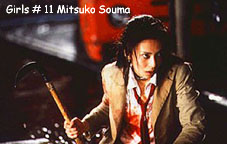
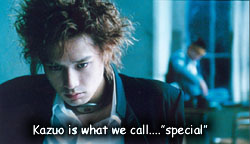 Of course, the villains outshine everyone else. Kou Shibasaki as Mitsuko Souma can turn on the waterworks, then stab you in the back with stone cold eyes, just like in the book. Masanobu Ando portraying Kazuo Kiriyama is vicious. His eyes light up with insane joy as he fills his prey with lead, or dismembers them. Kazuo's character is quite different in the film from that in the book but he is no less menacing, and perhaps even more so. In the pulp version, Kazuo was born without emotion, but Ando's portrayal of Kiriyama is a demon that smiles with glee when he's shot at.
Then there is Taro Yamamoto as Shougo Kawada. Despite the fact that he's often seen on Japanese television running around naked with tribesmen in Africa, Taro Yamamoto just oozes coolness. As the tough-guy exchange student that nobody trusts, his body covered in scars, no one wants to get near him. Every time he pumps his shotgun, the viewer wishes they could look that awesome. Add to that a Kansai accent and he instantly becomes the smooth badass of the film.
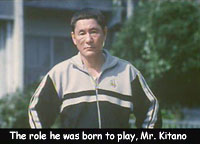 And of course the one and only Kitano "Beat" Takeshi playing the demented former teacher, Kitano. In this respect the movie is vastly different from the book. The Program leader in the novel, Kinpatsu Sakamochi, was almost a feminine character with long wavy locks of hair who cracked sick jokes. Kitano is a no-nonsense martinet. Like I said earlier, after the first five or so times of viewing the film, instead of feeling sick you actually anticipate the violence; like the first time he shows the class that he doesn't like whispering during "class" (you'll know what I'm talking about when you see the movie). Some say that Takeshi played the role only because Fukasaku was originally signed to direct Takeshi's breakout success as an actor and director, Violent Cop. Regardless, Takeshi is scary as Hell here. I would strongly suggest you see Takeshi's award-winning drama/comedy film "Kikujirou no Natsu" before BR, or you'll never see him the same way.
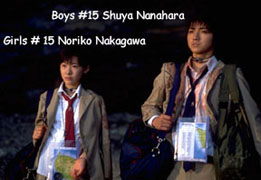 Having covered all the menacing figures, one might wonder where that leaves the protagonist duo, Shuya Nanahara and Noriko Nakagawa portrayed by Tatsuya Fujiwara and Aki Maeda respectively. Both come across as innocent figures caught in the middle of a battlefield; Shuya because of his pure desire to protect Noriko, and Noriko is the only person who is able to see good in anyone. Aside from Shuya's persistence, made evident in the latter half of the film, they do not stand out as particularly interesting characters, but that is not to say the actor and actress do a poor job. It might be possible to argue that Shuya represents an ideal male Japanese figure with Noriko as the female counterpart. The viewer will be caught up in the drama, hoping for the impossible, a way for both of them to get out of the game.
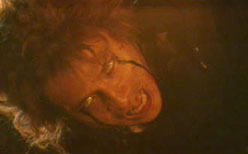 To tell the truth, I do not have much data on the origin of the Battle Royale manga. I do know that it is still published by Young Champion Comics and as of this writing, Volume 9 has been released. I purchased the first volume a while ago and was, quite frankly, terrified. Scenes from the book, which were easy to handle, suddenly became real, and unlike a movie, the horrible images don't go away, they are always there on the page.